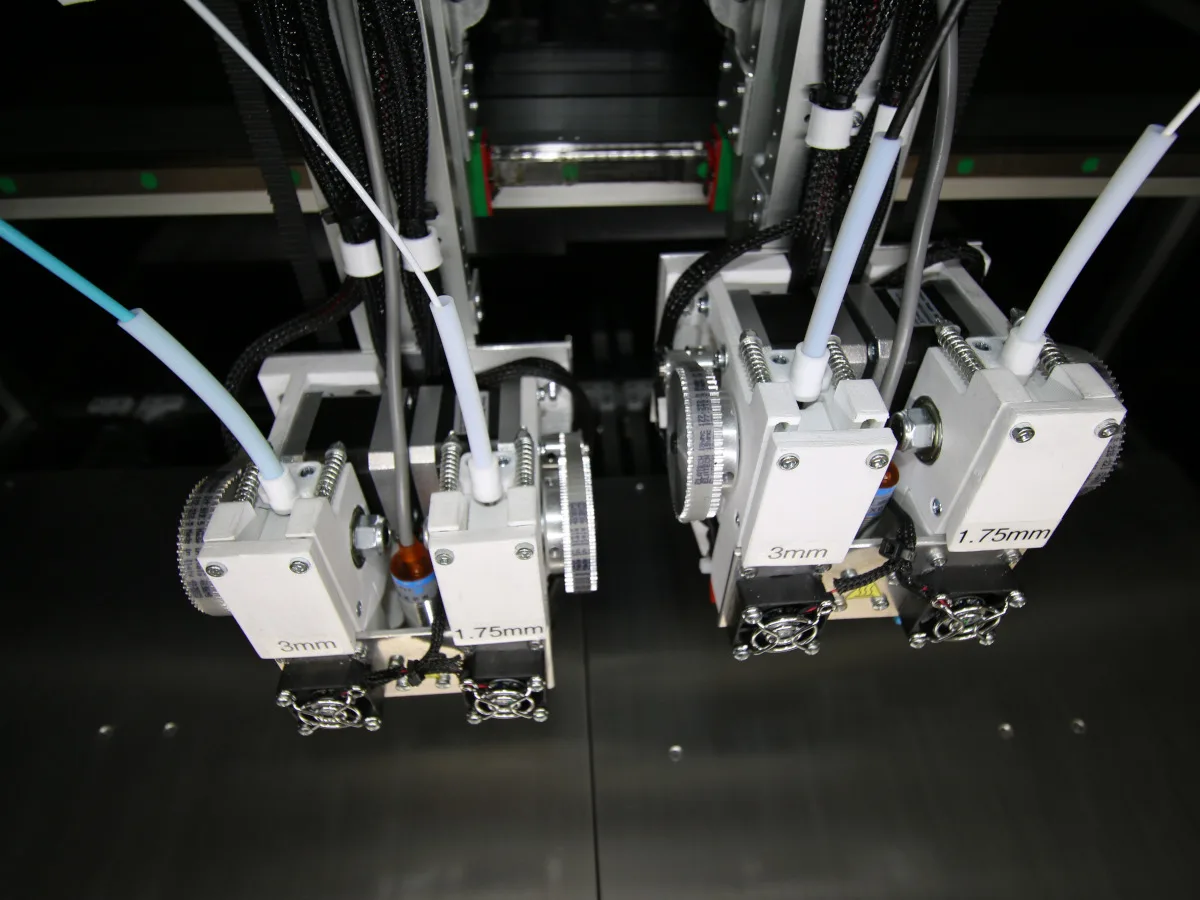
Large-format professional 3D printers are transforming the way companies develop, test, and produce certain components. The evolution of large-format additive manufacturing allows companies to move from initial prototypes to the production of functional parts, tools, custom components, and small batches using a predominantly digital workflow.
In the initial phase of a project, 3D printing allows for the rapid transformation of a CAD design into a physical model. This facilitates verification of dimensions, geometry, ergonomics, assembly, and functionality before making final production decisions. Once the design is validated, the same technology can be used, in certain applications, to produce multiple units of the component.
This seamless transition between prototyping and production is one of the main advantages of additive manufacturing. The company can maintain the digital model as the basis of the process and modify it when new versions are needed. This reduces the gap between design and production and allows the production process to be adapted more quickly.
From digital design to the first prototype
It usually starts with a 3D CAD model . The file contains the component’s geometry and allows you to prepare the various conditions required for production.
Before printing a large component, it is important to analyze the model and check aspects such as thicknesses, tolerances, orientation, joins, and areas that may require support structures.
Proper preparation allows you to fully exploit the potential of a professional large-format 3D printer and reduces some production issues. Furthermore, the design can be optimized to reduce material consumption or component weight.
Large-scale prototyping
One of the most important applications of large-format 3D printing is the creation of full-scale prototypes. In some projects, a small-scale model doesn’t allow for proper verification of the product’s features. Actual dimensions can be crucial for evaluating ergonomics, the integration of different components, or the available space.
Creating a full-scale prototype allows for physical verification of the design and the identification of issues that might not be apparent during a digital simulation. This facilitates the decision-making process and allows for adjustments to be made before final production begins.
Among the aspects that can be verified are:
- Dimensions and proportions .
- Ergonomics.
- Assembly systems.
- Compatibility between components.
- Accessibility.
- Geometry.
- Positioning of the different elements.
Reduce development times
Rapid prototyping is one of the main reasons companies are integrating additive manufacturing into their processes. The ability to produce directly from a digital file allows for the elimination of certain steps that, in other processes, might require specific tools or preparation.
When a design needs changes, the CAD model can be updated and used to produce a new version. This enables a continuous cycle of design, manufacturing, testing, and improvement .
The faster this cycle is completed, the greater the company’s ability to experiment with different solutions before arriving at the final product.
Moving from prototype to production
Once the design is validated, 3D printing can be used in certain applications to produce small batches of functional components . This is particularly useful when the quantities required are not large enough to justify other specialized processes.
The transition can be made using the same digital file, although the material, printing parameters, or some design elements can be changed.
The process can therefore evolve from an initial prototype to limited production without the need to completely change the methodology.
Miniseries production
Low-volume production represents a particularly interesting application of additive manufacturing. When a company only needs a few units of a component, some costs associated with molds or tools can be significant.
3D printing allows for production directly from a digital model, producing only the necessary units. It also facilitates the creation of different versions of the same component.
This is especially useful for specialized products, custom components, niche projects, and low-volume industrial applications .
Custom components
One of the main advantages of additive manufacturing is the ability to customize each individual component.
The digital model can be modified to adjust dimensions, mounting points, geometry, or specific functional elements. The new version can then be sent directly to production.
This feature enables quick response to specific needs and is particularly interesting for companies working with customized products or different configurations .
Production of large components in a single section
The large build volume of a professional 3D printer allows you to make large components in a single piece.
This capability can reduce the number of joints and some subsequent assembly operations. It can also facilitate the evaluation of a complete prototype.
However, it’s not always cost-effective to produce the entire component at once. An extremely large part may require long production times and more complex thermal management.
Modular production
Modular manufacturing allows a large component to be divided into multiple sections. Each module is produced individually and then assembled with the others.
This approach can facilitate transportation and handling, while also allowing for the orientation of each part to be optimized.
Another advantage is the ability to modify only one section of the component. If the project changes, in some cases it will be sufficient to redesign only the affected module.
Selection of materials
Moving from prototyping to production also requires choosing the most suitable 3D printing material . The appropriate option depends on the intended function of the component.
Materials used in various professional applications include PLA, ABS, PETG, polycarbonate and polyamides , as well as fiber-reinforced materials and various composite materials.
A conventional thermoplastic material may be sufficient for a visual model. However, a functional component may require superior mechanical or thermal performance characteristics.
Technical materials and functional components
Engineering materials expand the possibilities of additive manufacturing. In certain applications, fiber-reinforced materials can be used to achieve a specific combination of stiffness, strength, and weight.
The choice must be made taking into account the actual conditions of use. It is also essential that the printer and extrusion system are compatible with the selected material.
A suitable material, combined with correctly configured parameters, can improve the quality and repeatability of components.
Design for additive manufacturing
To go from prototype to production, it’s not enough to use a large-format printer. You also need to optimize the design for additive manufacturing .
A component designed specifically for 3D printing can take advantage of internal structures, complex geometries, and integrated joining systems. Furthermore, the designer can modify the geometry to reduce material consumption and simplify production.
This strategy allows you to find a balance between strength, weight, costs and production times .
Reduction of material consumption
Lightweight internal structures allow certain components to be produced using less material.
A substantial part doesn’t need to be solid. The density and geometry of the filler material can be adapted based on the required mechanical properties.
Reducing the amount of material used can help reduce weight, cost, and print times. This is especially important when producing large components.
Productivity during production
As 3D printing moves from prototyping to production, productivity becomes critical.
Print speed must be evaluated alongside quality and reliability. An excessively fast setup can cause defects and increase the number of parts requiring reprinting.
Therefore, actual productivity should be measured by the number of correct parts produced in a given period , also taking into account setup times and subsequent operations.
Repeatability of components
Repeatability is essential when producing multiple units of the same component. Stable production allows for similar characteristics to be maintained across different parts.
Standardization of parameters, material control and machine maintenance help improve the consistency of results.
This is especially important when 3D printing is used for small batches or components intended for functional applications.
Quality control
The transition to production also requires an adequate quality control system .
Depending on the application, components may be subjected to dimensional checks, visual inspections and functional tests.
Inspecting the first units of a production run allows you to identify potential deviations before proceeding with the entire production process. This helps reduce the risk of producing a large quantity of parts that do not meet established requirements.
Industrial tools and equipment
The professional 3D printer can also be used to create tools, jigs, supports and equipment intended for production itself.
A company can design a specific tool for an assembly operation and quickly produce it using additive manufacturing.
If working conditions change, the model can be modified and reproduced. This flexibility allows production methods to be adapted to specific needs.
Spare parts
Additive manufacturing can be particularly useful for some spare parts .
When a component becomes unavailable or is only needed occasionally, preserving its digital model allows it to be reproduced when needed.
For large components, this option can be particularly interesting because it avoids having to keep large quantities of physical parts in stock.
Production on demand
The connection between digital design and manufacturing also enables working with an on-demand manufacturing model .
The company can maintain different files and produce components only when needed.
This approach can be suitable for custom components, slow-turnover components, and small production runs. It also allows you to adapt production to actual demand.
3D printing and large format production
In the field of professional large-format 3D printing , 3DPRN is associated with solutions oriented towards large-format additive manufacturing.
To utilize this type of technology, from prototyping to production, it’s essential to analyze the characteristics of each project. Print volume, materials, precision, productivity, and reliability must all be evaluated together.
The most suitable solution will be the one that allows you to maintain a stable and efficient process both during the development phase and during production applications.
Process Automation
Automation can further enhance the potential of additive manufacturing. Job preparation, monitoring specific parameters, and process standardization can reduce manual intervention .
For a company that regularly uses 3D printing, automating repetitive tasks allows for better use of operator time and greater consistency in production.
The combination of additive manufacturing and automation enables more organized, repeatable, and scalable processes.
From prototype to final component
The true potential of a large-format professional 3D printer lies in its ability to support the different phases of product development.
The same digital workflow can be used to create an initial prototype, make changes, produce a new version, and then produce a small series.
This reduces the gap between design, validation and manufacturing , making the process more flexible.
Economic benefits
3D printing can offer several economic benefits when the applications are appropriate. Reduced tooling requirements, the ability to produce on demand, and the ease of design modification can help control costs.
However, it is important to always evaluate the total cost per part , including materials, energy, machine time, labor, maintenance and subsequent operations.
Only in this way can additive manufacturing be correctly compared with other alternatives.
The large-format professional 3D printer allows you to create a workflow that can start from prototyping and, in certain applications, go all the way to the production of small series and functional components.
Its ability to work directly from a CAD model facilitates modifications and enables faster iterations. Large-format manufacturing allows for the production of bulky components in a single piece when conditions permit, while modular manufacturing offers a solution for even larger objects.
Proper selection of materials, parameters, orientation, and design is essential to obtaining precise and reliable components. Repeatability, quality control, and automation also become increasingly important when the technology is used for manufacturing purposes.
In this way, large-format additive manufacturing can support companies from the initial design stages to specific production applications. The combination of rapid prototyping, customization, on-demand production, and small series makes professional 3D printing an increasingly important tool for companies looking to develop large-scale products and components flexibly and efficiently.